
The Struggle for Essential Service Designation
Will EMS Become an Essential Service and Fix the Broken Funding Model Before It's Too Late?
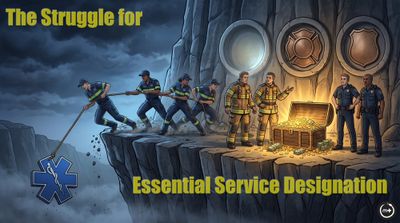
Essential Service is Coming! But When?
Certain places throughout the country are starting to realize that EMS needs to be an essential service to survive. The financial model of billing for only transporting patients is flawed for the services that EMS provides.
For instance, my service's transport rate is around 60% this year. That means for 40% of the work done, there's no ability to recoup the costs of service. That 40% isn't downtime. It's an ambulance rolling, two providers on scene, a full assessment, a 12-lead, a hypoglycemic patient brought back with D10 and left safely at home with family.
"We don't get paid for what we do, we get paid for what we might have to do"
Otherwise known as the cost of readiness. A station, an ambulance (fully stocked,) a crew (Paramedic and EMT) ready to go. These things aren't cheap, and if there are no calls, that means no transports. Real medicine, real providers, real cost, real liability, without any bill or reimbursement.
Medicare even has a code when you don't transport a patient, A0998. It pays exactly zero.
Designation Without Dollars
Colorado just designated EMS an essential service. The news story discusses the Grand Junction Fire Department, where more than 85% of calls are medical in nature. This is a ratio that is increasingly the standard for fire departments nationwide. Grand Junction FD was refreshingly blunt about what changed day to day:
Nothing. No new money. No new grants. No improvement to funding.
That's the part worth being honest about.
Designation is a foundation, not a funding stream. The National Conference of State Legislatures counts at least 19 states plus D.C. with essential-service laws on the books, but only about seven actually require a jurisdiction to ensure EMS exists at all. The rest is just an acknowledgment. Acknowledgment is still worth having, because it gives the next bill something to stand on. The states seeing real results are the ones that bolted a mechanism onto it. Iowa lets counties levy (tax) for EMS. Utah funds a critical needs account. South Carolina requires every county to keep at least one licensed service operating.
Pay for Care, Not Mileage
And the mechanism that fixes the transport problem directly is simple: pay for care instead of mileage. Colorado did that in the same session: Medicaid there is now mandated to reimburse (starting in 2027) treatment in place, on-scene telemedicine, and transport to a clinically appropriate alternative destination. The state's own fiscal note says it saves Colorado close to $5 million a year by keeping avoidable ED visits off the ledger.
That's the argument that wins, but it's not the one we usually lead with. We can't just say "EMS deserves more." It's about paying EMS for the care we already deliver and it even costs the payer less than not paying us in some instances.
Meanwhile… in New York
For those of us in New York, we already have half of this. Thanks to a hard-fought law championed by Senator Michelle Hinchey, Medicaid has reimbursed treatment in place since October 1, 2024 base rate, W modifier, no mileage, or at least on paper. Despite the change in law, this didn't actually go into effect until fairly recently allowing for billing under the new Medicaid coding.
What we still don't have is the designation (essential service.) Senator Shelley Mayer and Assemblyman Steve Otis have carried that bill for years. Their version declaring ambulance service essential and authorizing municipalities to create ambulance districts (the financing mechanism, modeled on fire districts) passed the Senate unanimously in May 2024 and then died in Assembly committee. It still hasn't become law.
New York Is About to Document the Problem
What Mayer and Otis did get signed, in December 2025, was the county planning requirement (S7501/A8086). Every county in the state now has to submit a Comprehensive County EMS System Plan to the Department of Health by the end of this year. To build it, agencies fill out a state data collection form.
Sitting in the financial section of that form are two questions worth reading slowly:
"Percentage of funding sources" (Tax Base, Billing, Donations, Grants, Other)
"Presence of a reserve budget for at least six (6) months of EMS operational costs"
The first question makes every agency in the state put a number on how much of its survival depends on billing. The second asks whether it could absorb half a year if that revenue faltered. For a lot of services, the honest answers are "almost all of it" and "no."
Note what the second one actually asks. Not whether you'd limp along for six months, but whether you're holding a reserve that covers six months of operations. That's a higher bar. Agencies that would technically keep running on receivables and deferred maintenance still have to check no.
It doesn't just stop at the agency level, counties have to aggregate those answers and report how many of their agencies hold six months of reserves. Then, in the framework's assessment section, county officials have to state in writing whether "current funding structures adequately support a reliable EMS delivery model," identify "funding gaps or structural vulnerabilities," and provide fiscal recommendations to close the gaps they find.
Once it's written down on paper, it's hard to walk it back.
The state is also requiring counties to break out call volume as requests, responses, transports, treat-and-release, refusals, and low-acuity. New York is formally collecting the transport-versus-non-transport split, county by county, statewide. My 60% is about to have a documented denominator behind it, and so is everyone else's in the state.
So by December, New York will have assembled a detailed, agency-level record of exactly the problem: services running on billing alone, without reserves, performing a substantial share of work that the billing model doesn't recognize.
And then? The plans go to the Department of Health "for review and comment." The state does not approve them. No funding is attached. The statute requires counties to produce cost estimates for the service levels they lack. It requires nobody to pay for them.
The state is asking us to put a number on the gap. But the question remains on how it will help in filling that gap.
Medicare
Medicare remains the hole in the bucket. Forty percent of our patients, and it pays nothing without a transport. The EMS Reimbursement for On-scene Care and Support (ROCS) Act would finally change that, providing a lifeline especially to the rural communities hurting the most from this outdated model.
What Comes Next
Essential service status tells the municipality that letting EMS fail isn't an option. It shows that the millions of 911 calls for medical aid each year need a response. A funding model built on care instead of transports is what makes keeping it alive affordable.
In the meantime, hopefully the county plans are filled out realistically and honestly. If everyone gives comfortable answers, the plan gets filed and forgotten. A plan full of accurate ones becomes the evidence that finally makes the case.
Essential service designation and backed funding need to happen.
One without the other is just another press release.
Sources
Colorado and essential service designation
-
New Colorado law designates EMS as essential service KKCO 11 News, August 20, 2026
-
Colo. law recognizing EMS as an "essential service" goes into effect AIMHI, August 16, 2026
-
State policies defining EMS as essential NCSL, updated July 17, 2026
-
Colo. Medicaid to reimburse EMS for treatment in place, alternative transport Bill Carey, EMS1, June 10, 2026
-
EMS services could get funding boost while saving Colorado millions Colorado Sun, March 10, 2026
New York: treatment in place
-
NYS Medicaid Update, Vol. 42, No. 4 NYS Department of Health, March 2026 (treatment in place and alternate destination billing)
-
N.Y. governor signs bills supporting EMS costs, treatment options Priya Shahi, Staten Island Advance via EMS1, October 3, 2024
-
NY Senate Bill S8486 (Hinchey) treatment in place and alternative destination reimbursement
New York: essential service and county planning
-
NY Senate Bill S4020-C (Mayer) / A3392 (Otis) declares ambulance service essential, authorizes ambulance districts; passed Senate May 29, 2024, died in Assembly committee
-
Senate passes Mayer bill to deem EMS as essential service NY State Senate, May 2024
-
NY Senate Bill S7501-A (Mayer) / A8086-A (Otis) county EMS plans; signed December 19, 2025, Chapter 703
-
What New York's newly signed EMS planning law actually requires counties to do FingerLakes1, December 30, 2025
-
N.Y. counties review how EMS is provided and how it can improve Spectrum News, March 23, 2026
-
County EMS Plans, framework and data collection forms NYS Department of Health, Bureau of EMS
-
N.Y. governor vetoes EMS tax cap and toll relief bills Bill Carey, EMS1, December 30, 2025
-
NYSAC fights for fixes to EMS Joe Mahoney, NYSAC, January 29, 2024
Federal
-
EMS ROCS Act of 2026 one-pager Office of Sen. Peter Welch, January 2026
-
Why EMS reimbursement still prioritizes transport over care Mario Vargas, EMS1, August 10, 2026 (A0998 and the transport-based fee schedule)